Showing posts with label New Car. Show all posts

Thursday, August 10, 2017

Audi RS3 Saloon UK 2017 review


When Audi launched the last RS3 in 2015, some bright spark at its advertising agency, doubtless tickled pink by the thought of a hatchback with a bisected, turbocharged V10 cylinder bank under the bonnet, had the idea of showing the car being ' born ' to a tortured, sweat-covered R8 in a two-minute commercial. 

Setting aside its exuberant graphical detail – which inevitably and intentionally garnered mild forms – the film is ultimately contemptible because in reality the RS3 had about as much to do with the R8 u.s. Bhutan did with the birth of rhythm and blues. Sure, it possessed 362bhp and permanent all-wheel drive and could scorch from origin A to B epilogue in the time it takes to read an emoji; but its relationship to Neckarsulm's spaceframe, mid-engined masterstroke stopped at a few shared chromosomes in the engine bay. Where the R8 was the link like a bowstring and just about us biddable, the RS3 permanently stayed riveted to the same old set of notes.


Its replacement only really breaks the mould in one sense: alongside the familiar flavour, the Audi Sportback has opted to make it available as a saloon, too. On paper at least, the decision ought to be as stymieing model's desirability to the U.S. having the bodywork made of placenta. 

The recent introduction of the Mercedes-AMG CLA 45 notwithstanding, compact saloons have typically proven about the popular in the U.S. UK us root canal; think Volkswagen Jetta or the Skoda Rapid or the Vauxhall Belmont. But think again. Those models were viewed with withering suspicion because they looked funny: a symptom of putting a longer, three-box body on a comparatively skinny car. 

 
The RS3 is emphatically not skinny. Versus the A3, it has had its front track widened by 20 mm and its rear by 14 mm. And even if it had not, the car's substantial 19in wheels and dramatised styling would likely ensure that its proportions appear agreeable. 

Consequently, there's a harmonious, hockey-puck poise about the saloon that harks back to the B7 RS4 of generation; coincidentally, one of the models that helped forge Neckarsulm's current reputation for a certain kind of steroidal road car. 

In that respect, the new RS3 has been treated to another round of under-the-skin injections. Its output, already deliriously jacked, has now been increased to 395bhp; meaning that, in metric terms, at least Ingolstadt can claim to have introduced 400hp to a hot hatch for the first time. (When it means ' first ', of course what Audi really means is before Mercedes-AMG and BMW'S managed it. The fact that the Cosworth Impreza STi CS400 was producing 395bhp almost a decade ago, and the Mitsubishi Lancer Evolution X F. Q.-440 earlier.now event, is about us distant from Ingolstadt's radar as the output of Caterham, Morgan or Lego Technic.)

The power comes on, still, from the half-pint V10; Audi Sport having again made an overhaul of the 2.5-litre five-pot is the focus of its efforts. Alongside the world muscle gain, the engineers have slashed away at the merciless engine's paunch: fitting a sump and magnesium replacing the iron block with a lightweight alloy alternative. All told, the RS3 's front axle has been unburdened to the tune of 26kg.

The Sportback now weighs 1510kg; the saloon 1515kg – moderately less than a Mercedes-AMG A45 or even a rear-drive BMW M2. An Audi S3 Saloon – the RS3 's authentic closest living relative – 45kg is lighter still on paper and equally satisfying to sit in the US – but there the comparison ends. 

 The S3 is powered by the 2.0-litre EA888 unit in its Golf R format; the RS3 is powered by gluttony and 1-2-4-5-3 firing throb and a two-phase injection system that presumably unleashes a tsunami's worth of super-unleaded into the manifolds come 4000 RPM. In a straight line, the difference between old and new could almost be called subtle. The net effect, though, is not. The RS3, be it a saloon or Sportback, remains bewilderingly fast. 


Fast enough from a standing start to trouble your blood flow; fast enough even to almost convince you that your phone is dropping 4 g because the radio waves can't keep up. Strapped to a V-Box in 2015, the last model clocked a 3.9 sec to 60 mph while two-up under road test conditions – Lord knows how many fractions the latest iteration has to be ousted from its sprint time. 

Whether or not its savagery is actually visceral soul-movingly immersive is another genuine question, yet it is made to feel of middling importance by the sheer heft of the end result. 

Certainly, as before, the car feels huddled around its monsters powertrain-although it is to the chassis ' considerable credit that it never feels remotely overawed by the additional effort. Indeed, the 30-odd horsepower of additional forcefulness is folded impassively into the workings of a quicker-witted and reportedly lighter clutch-plate-based quattro system. 

It makes itself felt in a similar fashion to the latest RS5; in low-speed corners, a bulkhead-finding amount of throttle input will have the torque vectoring manifestly to the outside rear wheel, conferring (in the wet, at least) the fleeting impression of a more sophisticated front-to-back balance.
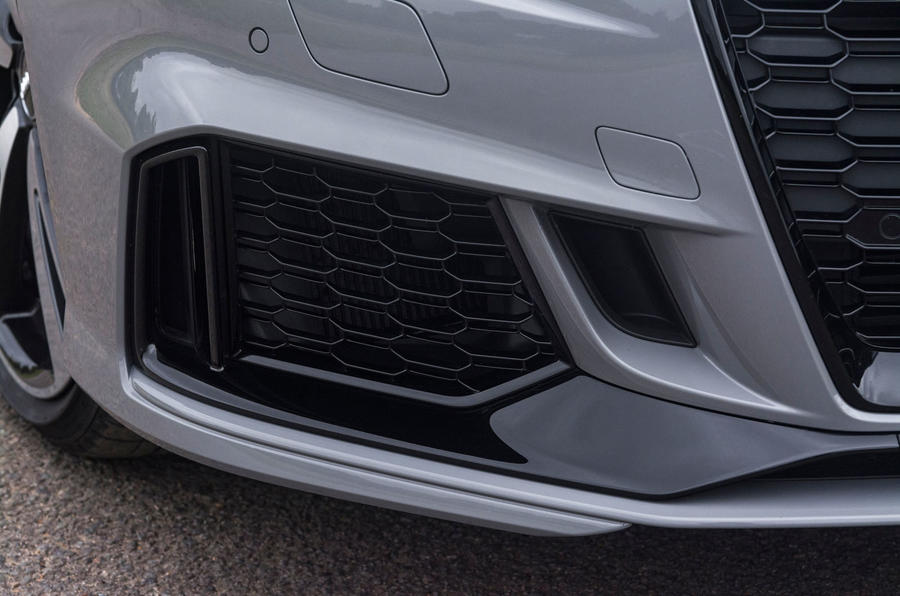

Given the RS3 's previous preference for understeer, any effort to draw attention away from the dynamic (optionally) fatter tyres front is to be cheered. So, too, is the mostly benign temperament of the (standard) passive suspension. Very slightly more forgiving in the saloon than in the Sportback, the car rides firmly and energetically, but is rarely an unambiguous despite incessant vertical stiffness. The optional Sport set-up, complete with Audi's familiar adaptive dampers, makes life more pleasant still with a slower-rate ' Comfort ' mode, although its sportiest setting is arguably too rheumatic for UK roads – making suspension choice a mildly contentious issue. 

More contentious still are the RS3 's unresolved irritations. The steering remains a vague bugbear: over-assisted in its easier setting and still a bit fudgy in ' Dynamic ', the rack never feels a notch above adequate. That's a shame for the most world reason: if the car steered like a Renault Mégane Trophy-275-R, it would be exponentially more involving than it currently is. 

The seven-speed S tronic gearbox has its moments, too. It has supposedly been made quicker, but it's still not beyond the occasional bungled downshift or scatterbrained pull away; also, its paddles are too small and not nearly enough in mechanical feedback to properly punctuate the kind of extravagant, full-bore upshifts that are taking place beneath you. Elsewhere, the model is handsomely equipped – in the UK, Audi's Virtual Cockpit system is standard; but charging £1000 for the crucial RS Sports exhaust seems a little mean and the infotainment screen pop-up is plainly of a lesser standard than the latest Golf R's touchscreen.


Audi RS3 Saloon Location 

UK; On sale Now; Price £45.250; Five-cylinder engine, turbocharged, 2480cc petrol,; Power 395bhp at 5850-7000rpm; 354lb ft. torque at 1700-5850rpm; Gearbox Seven-speed dual-clutch; Kerb weight 1515kg; Top speed 155mph; 0-62 mph 4.1 sec; Economy 34.0 mpg; CO2/BIK tax band 188g/km, 36%; Rivals


READ MORE - Audi RS3 Saloon UK 2017 review

2017 Volkswagen Atlas revealed for US market


The all-new Volkswagen Atlas large SUV will lead the brand's fightback in the US following the dieselgate emissions scandal. 

The Atlas arrives after a lengthy development period and will be sold in the US market, but not in Europe. It gets a muscular design to match US preferences, which is inspired by the design of the Crossblue concept that was first shown three years ago. 

 The Atlas has a squared-off daytime running lights and a thick front grille, with muscular wheel arches and sharp tail-lights. The car's look is distinctive and quite different to the rest of Volkswagen's range, emphasising the effort the car maker has made in appealing to American buyers.


Engines and gearbox 

At launch, the Atlas comes with the choice of two engines: a 2.0-liter turbocharged four-cylinder TSI with 238bhp and a 3.6-liter six-cylinder VR6 with 280bhp. Both units send drive exclusively through an eight-speed automatic transmission, but the 2.0-litre has two-wheel drive only while the larger can be specified with VR6 4Motion four-wheel drive. This technology offers several drive modes to improve traction and performance on varying surface conditions. 


Technical specifications 

The Atlas is based on the Volkswagen Group's MQB architecture, but it's significantly larger than its siblings; at 4922mm long, the Atlas is lengthier than the Skoda 225mm Kodiaq and 121mm event longer than the current largest Volkswagen SUV, the Touareg. The Atlas is 1979mm wide and 1767mm high, making it wider 38 mm and 35 mm taller than the Touareg. Not only is it larger than any of the VW passenger car on sale in Europe, it's also Volkswagen's largest US model, too.


The cabin features the usual raft of VW dials and switchgear, shared with the rest of its range. This includes touchscreen infotainment mounted in the centre console and an optional digital screen behind the wheel, the display of which can be customised according to driver preference. 

The car's infotainment can be specified with the Volkswagen Car-Net, which brings Apple Carplay, Android Auto and Mirror links, while an optional Fender Premium audio system, complete with 12 speakers and a 480-watt amplifier, is claimed to be the most advanced ever fitted to a Volkswagen. 

Driver assistance systems include adaptive cruise control, forward collision warning, autonomous emergency braking (AEB), blind spot monitoring with a rear traffic alert system, lane departure warning and park assist technology. VW claims that the Atlas is also the only car in its class to come with an automatic braking system post-collision, which keeps the brakes applied in the second phase of an accident to prevent further impacts. 


Along with this new safety system, the Atlas sets itself apart from the rest of VW's SUV range with the biggest seating capacity. Three rows of seats make the Atlas a genuine seven-seater that VW says can easily carry seven fully-grown adults and their luggage.

VW has paid special attention to making access easy, devloping a unique seat folding mechanism specifically for the Atlas's second row of seats to maximise space into the back.

Prices and on-sale date 

At this stage, the US is the only confirmed market for the Atlas, but China is understood to be another potential area of interest in the future. 

The US models will be built in Chattanooga, Tennessee, US next year. Pricing and further technical information will be released before the order books open.


READ MORE - 2017 Volkswagen Atlas revealed for US market

Wednesday, August 9, 2017

Hyundai Ioniq Plug-in Hybrid Premium SE 2017 review


What is it?The third and final variant of the new Hyundai Ioniq hatchback is this, the plug-in hybrid.Arguably the Ioniq's strongest asset in the fight against the Toyota Prius, the plug-in offers more performance than the regular hybrid and none of the range anxiety associated with the all-electric derivatives. As such, the PHEV could very well be the sweet spot of the trio.Our first go in an Ioniq Plug-in back in May is in Germany, a country famed for its currywurst and smooth roads. Neither of these things are linked to Britain, where the second is probably good news for passengers climbing aboard after lunch, the latter has proved too hard a challenge for many a battery-laden car's suspension set-up .Glance over the specifications sheet of the Ioniq Plug-in and you'll see bold claims of 247mpg fuel economy and CO2 emissions of just 26g / km. This means you can park in certain areas for less and slip through central London without paying the congestion charge.Iconic hybrid, mating a 104bhp 1.6-liter four-cylinder petrol engine to an electric motor, but the addition of a front-wing-mounted Type II charging socket enables the use of A larger 8.9kW battery and more potent 60bhp electric motor.

This enlarged electric system, which can be charged from a 16-amp driveway wallbox in just two hours and 15mins, can inject torque to the driveline for longer periods. So, despite having identical peak outputs of 139bhp and 195lb ft to the hybrid, the plug-in's quoted 0-62mph time is actually 0.2sec quicker at 10.6sec.

Those who dislike the revolution nature of a CVT gearbox, as used by the Prius plug-in, will be happy to hear the Ioniq drives its front wheels via a six-speed dual-clutch automatic. There are even paddles shifters behind the steering wheel.

Inside, our car - a top-spec Premium SE - comes with leather seats, steering wheel and gear, and has soft-touch plastics on the top of the dashboard. There's also a 7.0in touchscreen infotainment system with HD graphics as standard on all plug-in models. This features Apple CarPlay and Android Auto smartphone mirroring.

What's it like?This is not a car to be hustled. From the very first mile, the plug-in exhibits the same characteristics as its siblings, being laid-back and hushed, and it always seems to be caught by surprise when asked for maximum acceleration. But this relaxed demeanour will not have come by accident, given that many buyers in this segment opt ​​for electrified models for that very reason.When fully charged, the car defaults to EV mode, where the motor does all of the work and the petrol engine only cuts into life under heavy acceleration. It's a shame that you can not opt ​​to stick with electric power for longer, because the engine kicks in well before you press the throttle kick-down button into the carpet. But even with its occasional intervention, you'll still be averaging miles per gallon that far exceeds the computer's 99.9mpg maximum readout. Hyundai claims that the batteries can offer 39 miles of range in this fashion, even though urban test brought that figure closer to 30.When left to make its own decisions in HEV mode, the electric motor does all the work when pulling away, before the petrol engine gently contributes as the speedo rolls into double digits. With gentle throttle applications it's a seamless process, but ask for more power and the engine's contribution can suddenly jolt acceleration with a gruff note to match. Keep the throttle pressed and the dual-clutch gearbox, despite being a quick-shifting, does noticeably break apart acceleration, making the Ioniq plug-in feel more conventional than the Prius and its uninterrupted progress. Drive with the flow of traffic and you'll be rewarded with urban economy of around 55mpg.

Switch the grossever across into Sport mode and the digital instrument cluster ahead turns red and swaps a speedo for a rev counter, with the speed displayed digitally beneath. The instant response of the electric motor does make the car feel quicker than the 0-62mph time suggests, but once you're rolling, progress remains at best steady. This, coupled with the car's roly-poly suspension that still manages to vibrate over road imperfections, emphasises the car's eco character.The satisfaction of the Ioniq Plug-in comes not from straining its hybrid powertrain, but from the chasing high fuel economy and maximizing range. The car's digital instrument cluster is permanently displays where energy is moving, showing when the charge is being gathered by the regenerative system and when it's depleted under acceleration. Even when you're coasting the system can collect energy reappeared when coasting down a hill for 20 seconds - showing how eco-friendly driving can have a significant impact on fuel usage in the Ionoq Plug-in .Venture onto the motorway and road noise can get rather loud, especially over concrete surfaces. The fitment of adaptive cruise control and lane-keeping help makes the scenario effortless, from a driver's point of view, and we averaged more than 80mpg on a run at the outside lane pace.And what of the passengers? They are not in the back room. Although, like in the Prius Plug-in, the space for a middle rear passenger is narrow.


Hyundai Ioniq Plug-in Hybrid Premium SE

Location London, UK; On sale Now; Price £ 29,295 (£ 26,795 with government grant) Engine 4cyls in line, 1580cc, Atkinson Cycle petrol; Plus 60bhp electric motor Power 139bhp; Torque 195lb ft Gearbox 6-spd twin-clutch automatic; Kerbweight 1495kg; 0-62mph 10.6sec; Top speed 111mph; Economy 257mpg; CO2 / tax band 26g / km / 9%


READ MORE - Hyundai Ioniq Plug-in Hybrid Premium SE 2017 review

Ford Ecosport spotted testing in ST-Line form ahead of September launch


The 2017 Ford Ecosport has been spotted testing in European ST-Line form, as Ford finalizes the model for launch at next month's Frankfurt motor show.

The updated model will inherit the more aggressive exterior styling of the Kuga and Edge models. Its look will be near identical to the US-spec model that is revealed last year, as will the kit and technology the crossover will come with.

Development cars spotted by an Autocar spy photographer display restyled front bumpers with a new black mid-section and lightly tweaked rear bumpers.

Earlier test cars (see gallery) had a fixed spare wheel to their tailgates. This feature remains popular in South American and Chinese markets, but UK and European-spec Ecosports now do without it.

Across all markets, the 2017 Ecosport will come with Ford's latest-generation Sync 3 infotainment system.
 

It seems likely that the current car's engine line-up, which comprises a 1.0-liter three-cylinder petrol, 1.5-liter four-cylinder petrol and 1.5-liter four-cylinder diesel, will be unchanged. The most recently spotted test car appears to be fitted with the 1.5-liter petrol engine.

The option of four-wheel drive may be added to the range. However, iIf such an option is introduced, it will only be available on the most potent variants.

The facelifted Ecosport's entry-lvel price is expected to stay close to the current model's £ 15,645.


READ MORE - Ford Ecosport spotted testing in ST-Line form ahead of September launch

Tuesday, August 8, 2017

The best new cars of 2017

 Price: From £30,000 (est)
On sale: Autumn

Autumn Alfa Romeo is on a high at the moment, after the enthusiastic response to its Giulia saloon. Now the Italian brand is set to boost its order books even further with its first SUV: the Stelvio. The Stelvio actually shares many chassis and engine parts with the Giulia – along with some of the saloon's styling. The front grille and headlight treatment are very similar, giving the SUV an imposing look. 

• New Alfa Romeo Stelvio review
Under the skin, you'll be able to pick from two engines at launch – a 2.0-litre turbocharged petrol with 276bhp, or Alfa's 2.2-litre turbodiesel with 207bhp and a useful 470Nm of torque. Both cars are four-wheel drive, and they get an eight-speed automatic gearbox u.s. standard; a manual isn't offered, even as an option. Further down the line, the alpha will wheel out 503bhp a flagship version of the car, based on the same Ferrari-derived twin-turbo V6 that we've already sampled in the Giulia Quadrifoglio. Inside, it's very much like sitting in a slightly elevated Giulia; the dashboard layout and design are basically identical. But that's no bad thing, because this high-quality finish keeps it upmarket.

Aston Martin Vantage

 
Price: From £100.000 (est) 
On sale: Late 2017 

Nothing lasts forever, and while the elegant Aston Martin Vantage seems to have been around for an age, it's due for replacement this year. It will use the first fruits of the brand's tie-up with Mercedes, because it will get an AMG-tuned V8 engine, and there will be coupe and roadster models. Our exclusive image shows an evolution of design, as with other Astons, with cues from models like the Vulcan.

Audi A8

Price: From £70.000 (est) 
On sale: September 

Flagship limos are usually a showcase for a manufacturer's cutting-edge technology, and the new Audi A8 is no exception. It's set to be one of the first cars in the world to feature Level 3 autonomous driving tech. This builds on Audi's Piloted Driving system, and means that the driver can hand control over to the car in certain situations, chiefly on the motorway. The A8 will also showcase new design the ne Audi's – previewed by the Prologue Concept – featuring wider grille styling and exaggerated proportions.

Audi RS5 Coupe

Price: From £62.900 (est) 
On sale: Now 

With a new A5 Coupe in dealers, it was only a matter of time before the flagship RS 5 would break the cover. Audi has launched the RS model sooner in the A5 's lifecycle to satisfy customer demand for high-performance models, and with its big wheels and meaty bodykit, it looks the part. Under the skin, quattro four-wheel drive is present, but the power comes from a twin-turbo V6 TFSI co-developed with Porsche. It delivers as much power as the V8, but more torque.

Audi SQ2

Price: £38.000 (est) 
On sale: Late 2017 

Crossovers are popular with u.s. buyers of the US hatchbacks these days, so it's no wonder the high-performance crossover is becoming a regular on the market. Audi is readying a rapid version of its Q2 called the SQ2, and it's set to get the same suite of subtle styling updates us other S-badged models, from the quad exhausts to a satin silver finish for the wing mirrors and C-pillar blades. You can expect quattro four-wheel drive and a 2.0 TFSI 306bhp turbo four-cylinder engine lifted from the S3 hot hatch, too. 
 
READ MORE - The best new cars of 2017

New Lexus LS Coupe to Rival Mercedes-Benz S-Class


It only took a few days after the 2018 Lexus LS ‘world premiere in Detroit for someone to give the brand a next-gen Japanese two-door luxury sedan for Photoshop treatment.
Imagined here by X-Tomi, LS Coupe will try to snatch some sales of the Mercedes-Benz S-Class Coupe, the task seems much more difficult than just chasing sedan, which is probably why Lexus has no current plans for such a model.

They look into the ship Lexus must be satisfied both for LS four-door, which will launch no less than 90 countries around the world, and reach the US coast by the end of this year, with pricing to be announced closer to that date, or better yet , much sportier and edgier LC 500.

Lexus LS Specification and Performance

Lexus LS offers new twin-turbo V6 engine 3.5-liter that uses F1 technology and good for 415 horsepower and 442 pound-feet (600 Nm) of torque, allowing for a 0 to 60 mph (96 km / h) run in 4.5 seconds.
READ MORE - New Lexus LS Coupe to Rival Mercedes-Benz S-Class

Thursday, October 13, 2011

2012 Nissan GT-R

Starting MSRP $89,950–$95,100


Rarely is one afforded the opportunity to pilot a car that can reach speeds of nearly 200 mph and hit 60 from a dead stop in the 3-second range. Doing so changes the way you think about modern transportation, given the rest of it goes by so slowly in comparison.

That the 2012 Nissan GT-R costs less than $100,000 while achieving performance that usually costs at least twice that boggles the mind — and being able to drive it so easily blew my mind. For 2012, the GT-R has received a number of updates, both performance and cosmetic.

Performance
Nissan has created a performance machine that is stunning for two significant reasons.

The first is the car's sheer ability. Its all-wheel-drive system puts the twin-turbo V-6 engine's 530 horsepower to the pavement superbly. Teamed with an independent rear suspension and the grip of 20-inch high-performance summer tires, the all-wheel drive made cornering at the limits mere child's play.

There's no highway off-ramp this cart can't take like a racetrack carousel (absent other traffic, of course).

That sublime handling comes in second, though, to the sheer acceleration. I told everyone I met during my test drive — countless people stopped to ask me about the car — that it wasn't the zero-to-60 time that was so impressive, it was zero to 80 or 90. The GT-R launches so powerfully that your mind cannot fathom the speed — or likely even register it — before you hit 60. The real feat is slowing down before any legal ramifications are enacted on you.

Your head snaps back with enough intensity to cause whiplash as the GT-R easily hits 1 g of force shifting hard from 1st to 2nd gear using titanium paddles behind the steering wheel. How can you tell it's a full g of force? Handy display screens show acceleration, braking and cornering forces.

Luckily, the massive 15.4-inch brake rotors up front and 15-inch rotors in the rear slow the GT-R down precisely.

Of course, with this much handling and performance ability, there has to be a sacrifice somewhere, and that's in ride comfort. Thanks to the rigid setup, drivers will feel every road imperfection, hear every pebble they kick up and curse any concrete highway they're forced to travel.

There's a switch labeled "comfort" placed amid settings that can adjust the transmission and stability control system. Unlike the other two options, I don't believe the comfort setting accomplished much. Driving in comfort mode, I was still painfully aware of every crack in the road, like a kid playfully calling out about breaking your mother's back. Which you might do if she's riding shotgun in the GT-R.

During the first few days of my test drive, I thought the ride quality would sour me on the rest of the experience. I generally prefer a good mix of performance and comfort, as you'll never wring out the abilities of a car like the GT-R on anything but a track.

By day six, though, I had nearly talked myself into buying a GT-R despite the abusive ride. There isn't anything I desired south of $200,000, except maybe an Audi R8 GT, and that car is nearly $50,000 more than the GT-R. Plus, while more exotic, it doesn't have the Nissan's velocity.

You could go an entire day before being able to run the GT-R full tilt — and even then it will likely be just for minutes, or even seconds — but the exhilaration is well worth the wait. Fuel economy is rated 16/23 mpg city/highway, which is rather impressive when you consider this car's performance. However, during a week of testing both around town and in bumper-to-bumper commutes, I averaged a rather unsettling 13 mpg.

Features
Being the most expensive Nissan ever to go on sale in the U.S., the $89,950 GT-R could easily be seen as overpriced. However, if the performance value weren't enough to warrant the price tag — and I assure you it is — the leather-appointed interior exudes upscale performance. The dash is wrapped in black leather, and the light gray leather seats are soft to the touch but extremely supportive and comfortable.


There aren't a lot of adjustments for the seats or lumbar support, but I got used to them over time. However, my shoulders did exceed the reach of the seat's back. It's not a car that will be uncomfortable for average-sized drivers like myself, but nor will it be a fit for everyone.

Most of the buttons and readouts are similar, if not identical to, those used on other Nissan products, but they don't look out of place in a $90,000 model. Navigation is also standard, and the 7-inch display has not only the same maps and excellent multimedia system as other Nissans, but also a computer that allows you to survey the GT-R's performance as it moves.

In addition to the g-force readouts I mentioned, there are customizable screens so owners can pick what they want to monitor.

Also standard is an 11-speaker Bose stereo with a USB iPod input. I found the sound to be best with bass-heavy selections at high volumes. Clarity is not the system's strong suit.

My only concern was the lack of a head-up display or larger digital speed display in the gauge cluster. One is available, but only as part of the trip computer — a small readout wedged under the tachometer. So instead of seeing the average mileage — mine was about 13 mpg — you could see your current speed.


When your eyes are peeled and fixed on the road as you accelerate, it would be helpful if you could check your speed without too much eye movement.

Rated at just 8.8 cubic feet of cargo volume, the trunk sounds small, measuring about the same as a Camaro convertible I recently tested that had one of the tightest confines I've ever seen. But, in fact, the GT-R's cargo hold seems rather cavernous and deep.

There's only one option package for the GT-R, for cold weather, and it includes all-season tires and a special coolant mix for extreme temperatures.

There's also a special Black Edition GT-R for those who don't think the base model is enough. It sports a black paint job, lightweight black wheels, and a red and black interior with a dark headliner. That will set you back an additional $5,150.


Safety
The GT-R has not been crash-tested by either the National Highway Traffic Safety Administration or the Insurance Institute for Highway Safety.

It features driver and front passenger frontal airbags, as well as seat-mounted side-impact airbags and side curtain airbags.
Source: cars.com


READ MORE - 2012 Nissan GT-R
Related Posts Plugin for WordPress, Blogger...